Pureweld Stainless Steel Ltd
Pureweld specialises in the design, manufacture and installation of high-quality stainless-steel brewing equipment, with the ability to supply complete breweries up to 40 barrels. They offer a range of products and services that can provide breweries with entire integrated and automated systems.
Joining WYBPS
Exemplas worked with Pureweld through the West Yorkshire Business Productivity Service (WYBPS), delivered in partnership with Leeds Beckett University on behalf of West Yorkshire Combined Authority.
Pureweld began working with Exemplas in late-2023, with the objective of improving the overall productivity of their facility. Through working with our productivity expert, Jonathan McMullon, six key Productivity Improvement Indicators were identified. These measures act as the basis to identify baseline, target and actual levels of productivity improvement and are essential for providing business leaders with the opportunity to make data-driven decisions.
- Labour Productivity
- Leadtime
- Throughput Rate
- Direct Hours
- Overall resource effectiveness
- Time spent on value demand
We were able to facilitate a capital grant of £21,475 (25% of overall cost), provided through West Yorkshire Combined Authority, towards a new press break machine used for bending steel. This new machinery allows the use of larger pieces of stainless steel, reducing supply costs and waste. The production itself can become much more efficient and productive (when working correctly) by using the up-to-date technology.
The results
Pureweld Stainless Steel Ltd identified the need to invest in their equipment to optimise their productivity. By installing a new larger press brake machine in their manufacturing facility, they can use bigger stainless-steel sheets optimising usage and reducing expensive welds.
“The new machinery has not yet been used to its full potential, but we expect it to increase overall productivity by a further 75%.” – Mark Rushton, Pureweld Stainless Steel Ltd
Our team returned a year later and measured three main areas of notable improvement, explored below.
Labour productivity
Baseline level: £13.50
Target level set: £14.00
Actual achieved: £14.00
How we supported Pureweld:
We measured Pureweld’s Labour Productivity by calculating labour costs, including the costs for overtime, against sales within the same time frame. The investment in their new equipment has meant that their cost for labour is far more effective.

A productivity diagnostic revealed that Pureweld scored low on five key labour productivity indicators. As a micro-business with just four employees, setting a realistic and achievable target was essential. We aimed for a labour productivity benchmark of £14 per hour, which was successfully achieved following their investment in the new equipment.
Pureweld manufactures bespoke products using highly skilled labour. By understanding the output of their welders and machine operators, they’re better able to manage high-cost labour and maximise efficiency.
We also helped the team implement basic data collection practices. By recording job times and costs, they could begin comparing actuals against estimates – an essential step in understanding profitability.
Why does this matter? Accurate productivity data helps small businesses measure performance, manage labour costs, and increase profitability.
Throughput Rate
Baseline level: £500,000 per year
Target level set: £600,000 per year
Actual achieved: £621,000 per year
What is Throughput Rate?
Throughput Rate measures the value of goods produced within a set timeframe – calculated as total inventory value divided by time (e.g. £ per year). It’s a key productivity metric for understanding how efficiently a business turns materials and labour into revenue.
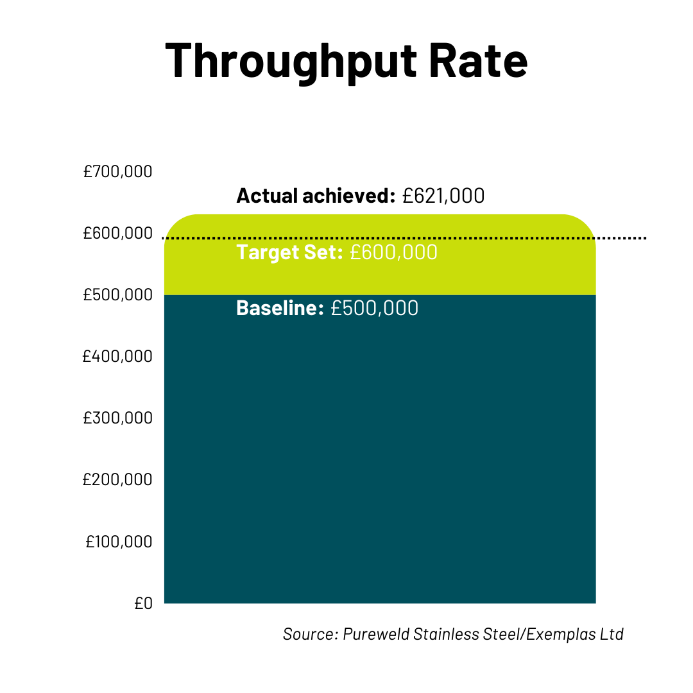
How we applied this measure to Pureweld:
In the case of Pureweld, we looked at the throughput rate on an annual basis to account for natural commercial fluctuations. This included measuring the total inventory and dividing the amount by the year. However, Pureweld continue to measure this indicator on a monthly basis to ensure they have constant access to make data-informed decisions.
Pureweld was forecasting a £100,000 increase in revenue, but a key bottleneck was slowing progress: the in-house production of control panels used in brewery systems. While these were important, they were diverting skilled labour away from their core work – high-quality welding and stainless steel fabrication.
Our academic partners from Leeds Beckett University suggested outsourcing control panel production to remove bottleneck to improve revenue generation. Pureweld made the strategic decision to remove the bottleneck to focus on increasing their capacity, take on more work, and accelerate revenue growth.
Overall Resource Effectiveness (ORE)
Baseline level: 39%
Target level set: 40%+
Actual achieved: 42%
What is ORE?
ORE is a key manufacturing metric that evaluates how efficiently a business uses its resources (including machines, labour, and materials) to generate value.
ORE = Availability × Performance × Quality × Utilisation
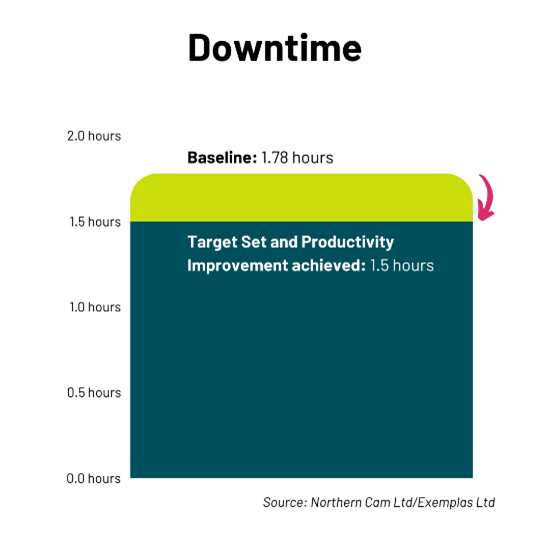
How Pureweld improved their ORE:
In the case of Pureweld, by outsourcing control panel production and investing in a new larger press brake machine, Pureweld improved several of the components that are factored into the ORE calculation.
Performance was improved through:
- Reduced costs for materials
- Better use of skilled welding labour
- Streamlined focus on more specialised production
Overall time spent on manufacturing their bespoke products was also reduced meaning they improved ORE by 3% in total. Materials and resources were used more efficiently resulting in improved overall resource effectiveness (ORE).
Client testimonial
“The Productivity Improvement Plans have allowed us to track our improved performance and look at the root cause of our downtime.” – Mark Rushton, Pureweld Stainless Steel Ltd
Key insights from Jonathan McMullon
“This is a great example of the very successful support Exemplas can provide. We identified key KPIs for the company to install and sustainably measure. The grant enabled Pureweld to buy new machinery which increase their productivity. Advice from academics at Leeds Beckett University enabled them to identify and remove bottlenecks and, overall, we were able to provide clearly identifiable valuable support for a micro-company to grow through productivity improvements.” – Jonathan McMullon, Productivity Manager