The challenge we set out to solve
The UK’s productivity problem is well documented. Since 2007 it has been the dominant challenge in British economic policy. West Yorkshire reflects that challenge acutely, GVA per job in the region runs below the England average, innovation activity among smaller businesses lags behind, and the proportion of businesses exporting has been falling since 2020.
Against that backdrop, Exemplas and Leeds Beckett University began building something different. Not another generic business support programme. Not a portal or a webinar series or a one-size-fits-all workshop. Something grounded in evidence, shaped by academic research, and designed around what actually changes business behaviour.
That partnership began in 2022 and has now completed two major programmes on behalf of West Yorkshire Combined Authority: the Leading Growth programme, focused on leadership capability and business-defined change projects; and the Export for Success programme, focused on helping West Yorkshire SMEs trade internationally for the first time or grow their existing export activity.
Both programmes have now been independently evaluated by Warwick Economics and Development. The results are in.
What made these programmes different
Most business support programmes are built around what’s easiest to deliver: workshops, information sessions, directories of advice. The Exemplas and Leeds Beckett University partnership started from a different place entirely, from research evidence about what actually changes the performance of an SME.
The starting point was a body of academic work from Leeds Beckett University, initially funded through the government’s Business Basics programme. This programme identified the effective principles of business support delivery. Those principles validated through 30+ years of Exemplas delivery experience, shaped every design decision in both programmes.
The key principles embedded into delivery were:
- Diagnostic-led engagement – every business started with a structured, in-depth conversation about their specific needs, capabilities and ambitions, not a generic eligibility check.
- Intensive, structured interaction – not a single touchpoint, but a sustained pattern of engagement over months, with real accountability built in.
- Change grounded in the business itself – participants on the Leading Growth programme defined their own change project. The programme supported its delivery. This is the critical distinction from programmes that stop at awareness-raising.
- Depth across the business – engaging a breadth of personnel, not just the owner or a single contact, to embed change rather than leave it resting on one person’s shoulders.
- Trusted adviser relationships – the human element. Both programmes consistently showed that the quality and continuity of the adviser relationship was what businesses valued most.
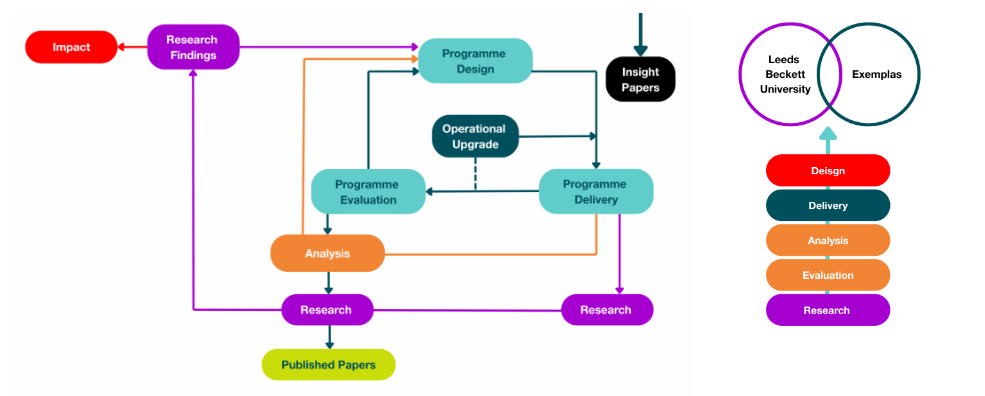
These weren’t design preferences. They were design principles built from research evidence and tested in delivery, what Exemplas and Leeds Beckett University have called the Triple Learning Loop (TLL), translating academic insight into programme design, then using live delivery experience to refine the model further.
Leading Growth: What the independent evaluation found
The Leading Growth programme supported business leaders across West Yorkshire to develop their leadership capability while delivering a real, business-defined change project over a structured three-month journey. The independent evaluation by Warwick Economics and Development, published in March 2026, assessed it against the OECD Development Assistance Committee criteria for public programme evaluation.
Its overall conclusion:
“The Programme is highly relevant, well-designed and effectively delivered, exceeding UKSPF targets and the majority of KPIs, and demonstrating an effective and scalable model for leadership-led business support.”
The numbers behind that conclusion tell a compelling story:
- 302 enquiries. The programme had capacity for 120. Demand ran at nearly 2.5 times what could be supported – one of the clearest possible signals of unmet need.
- 133 businesses and 144 leaders supported. That’s 111% of the UKSPF target for non-financial support, achieved within 11 months.
- 123% of the knowledge transfer target. Already exceeded before the programme closed.
- 72% of businesses rated the programme “very satisfied”. A further 16% were satisfied.
- 94% said they would recommend it to others. An unusually high net promoter signal for a publicly funded business support programme.
- The programme predominantly supported smaller businesses, with around three-quarters employing fewer than 50 people.
On inclusivity, the programme significantly outperformed national benchmarks:
- 44% of supported businesses had at least one female owner – against a national figure of 14% for female-led SME employers.
- 19% of supported businesses were minority ethnic-led – against a national figure of 6%.
The evaluators were direct about why the programme worked:
“The change-project-based model is highly effective and should be retained. It has proved that leadership development needs to be aligned to specific business needs and plans to be effective and successful.”
The personalised support from Growth Specialists was consistently highlighted as a key strength, and Leeds Beckett University’s role as programme partner was validated unequivocally:
“Leeds Beckett University were widely seen as being excellent facilitators and an important part of the programme.”
What this looked like in practice: Amity Brewery
Amity Brewery, a Leeds-based craft brewery with sites in Farsley and Bradford, joined the Leading Growth programme. The Sales Director identified a clear business challenge: refining their branding and sales strategy to accelerate growth.
Working with an Exemplas Growth Specialist and supported by Leeds Beckett University, the Sales Director developed a structured three-month change project addressing exactly that. The outcome was concrete and rapid:
- A 25% increase in monthly revenue.
- New partnerships formed with other businesses participating in the programme, directly generating increased sales.
- A new understanding of what a strategic relationship with a university partner could offer the business longer-term.
This is the model working as designed, not leadership development in the abstract, but leadership development that produced a measurable commercial result.
Export for Success: What the independent evaluation found
The Export for Success programme addressed a different but equally persistent challenge. West Yorkshire’s SMEs, particularly micro and small businesses are significantly less likely to export than their larger counterparts. They face overlapping barriers of cost, knowledge, capacity and access to networks., that no single intervention can address in isolation.
The programme’s response was an integrated offer:
- Structured export diagnostic
- Dedicated Export Manager support
- Expert-led masterclasses and workshops
- Small, matched grant to fund trade missions or specialist consultancy
The programme was delivered with specialist partners Chamber International and Medilink North of England, with Leeds Beckett University as strategic partner.
The independent evaluation’s summary verdict:
“The Programme has performed strongly in a short period of time (12 months) despite the uncertainty surrounding its continuation. EfS is well positioned to deliver sustainable and inclusive economic benefits for West Yorkshire.”
The headline numbers:
- 240 enquiries. Against a target of 180. 174 businesses supported against a target of 120, 145% of the UKSPF non-financial support target.
- 203.5 jobs created or safeguarded. Against a combined target of 180.
- £14.2 million in gross GVA generated or safeguarded from a public investment of £615,224.
- £23 of GVA generated for every £1 of public funding invested. £6 per £1 is directly attributable to the programme net of deadweight.
- 98% of respondents rated Export Manager support as “extremely valuable.”
- 100% of respondents said they would recommend the programme to others.
On inclusivity, the programme again outperformed national norms dramatically:
- 56% of supported businesses were female-led, against a national average of 14%.
- 23% were led by owners from ethnic minority backgrounds, against a national average of 6%.
The evaluators identified the Export Manager role as the central driver of success:
“The Export Manager role has been consistently identified as a key driver of success, providing trusted, tailored and accessible support.”
They also noted something important about the programme’s market position:
“A unique position in the market as there are very few programmes offering the same or similar assistance across West Yorkshire.”
What this looked like in practice: three businesses, three journeys
FE Tech – from Leeds to Singapore
FE Tech, a Leeds-based learning technology marketplace, used an Export for Success grant to attend EDUtech Asia, the major international education technology conference. In two days, the business forged commercial alliances that have already generated £50,000 in sales. They also opened conversations with around 30 potential new clients, with an expected £400,000 in revenue over the coming period. A new strategic partnership has been formed with a leading EdTech provider to support expansion across the Singapore region.
James Earl, Chief Executive, said: “The support from West Yorkshire Business Boost helped us accelerate plans that were already in motion. Attending EDUtech Asia gave us direct access to the right partners and customers, and the commercial outcomes have already been significant.”
Wellola – from Leeds to Minnesota (and then acquisition)
Wellola, an award-winning digital health software company, used Export for Success to build a structured entry into the US healthcare market including HIPAA compliance advisory, regulatory guidance, and a funded multi-day visit to Minnesota to meet potential partners and investors. The company expanded its team and opened substantive discussions with a private US healthcare network.
In March 2026, Wellola was acquired by Mayden.
Sonia Neary, Founder and CEO, reflected: “The Programme has played a pivotal role in helping us reach new markets, providing validation, business confidence, insight, tailored research and invaluable networking opportunities. The Export Programme has reinforced the immense potential for collaboration with the US healthcare sector.”
Brandon Medical – from West Yorkshire to Brazil, Mexico and Venezuela
Brandon Medical, a 70-year-old manufacturer of specialist medical equipment, wanted to attend MEDICA in Düsseldorf, one of the world’s largest healthcare trade fairs. A £2,000 Export for Success grant, combined with expert support from Exemplas partner Medilink, made it possible. The result: strengthened relationships with global partners, estimated meeting cost savings of up to £15,000, and four jobs safeguarded. In addition, promising contract discussions took place in three new markets they hadn’t previously entered: Brazil, Mexico and Venezuela.
Christina Hooley, Global Marketing Manager, said of her Exemplas Export Manager: “She took the time to understand our goals and her support was both strategic and practical and she made what could have been a complex process feel straightforward and achievable.”
Why this matters, and what comes next
The independent evaluations of Leading Growth and Export for Success are not just a report card on two programmes. They are evidence that a different approach to business support is possible, scalable and replicable.
The model that Exemplas and Leeds Beckett University have built over three years of partnership in West Yorkshire. Combining academic research with delivery expertise, diagnostic depth with sustained adviser relationships, and performance management with genuine flexibility has now been independently validated at scale.
The evaluators’ conclusion on Leading Growth was unambiguous:
“The Leading Growth Programme is a strong example of targeted, leadership-focused business support that delivers clear early value to MSMEs and aligns well with national and regional growth objectives. With modest refinements, the model offers a robust foundation for future investment in leadership and growth for businesses in West Yorkshire.”
And on Export for Success:
“The evaluation findings support the case for continued investment in targeted, place-based export support for businesses, with a focus on depth of engagement with businesses and inclusivity.”
Both programmes also speak directly to the government’s current priorities. The UK’s Industrial Strategy, the Backing Your Business agenda, the Trade Strategy, all of them identify SMEs as central to the growth mission, and all of them point to the need for business support that improves capabilities rather than just raising awareness.
The evidence base now exists. The blueprint is documented. The results have been independently verified.
For funders, commissioners, and economic development leaders looking to invest in business support that genuinely moves the dial, we’d welcome the conversation.
About Exemplas
Exemplas Limited is a national provider of business support and has operated for over 30 years, largely delivering programmes to SMEs on behalf of public funders including government organisations and local and combined authorities. During this time, Exemplas has supported over 600,000 businesses to grow and become more productive. Exemplas is wholly owned by the University of Hertfordshire.
About Leeds Beckett University
Leeds Beckett University is a key anchor organisation in the West Yorkshire region, committed to making a positive and decisive difference to people, organisations, and communities through excellent education, research, and services. Every year, the university delivers a £1.43bn impact on the UK economy, a return of more than £6 for every £1 spent on university operations.